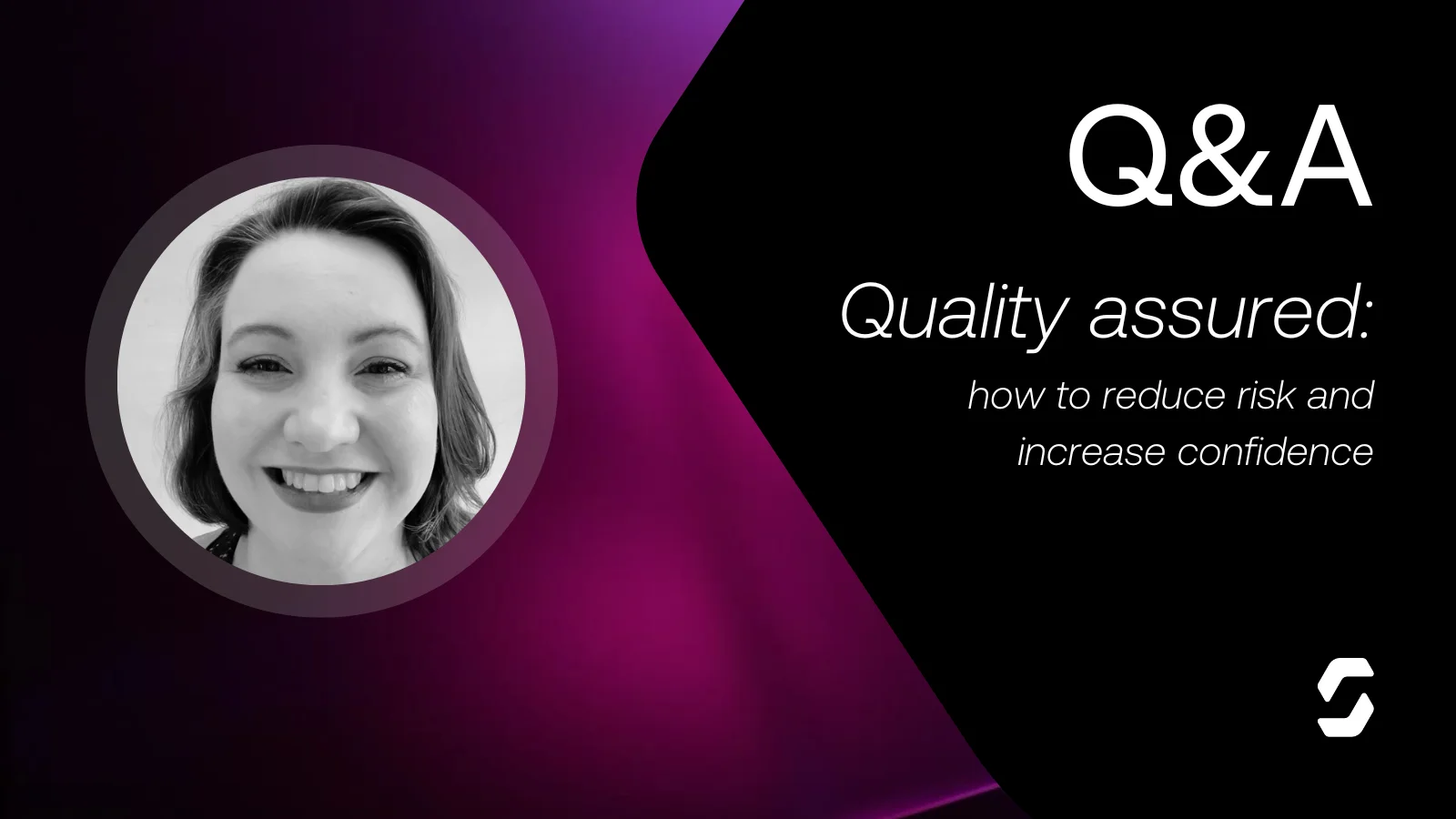
Quality assured: how to reduce risk and increase confidence
Customer centricity is at the core of our business. We’re obsessed with delivering a high quality Underwriting Workbench to our underwriting customers, helping them to do the job they love, but more quicky, efficiently and effectively.
To deliver this consistently, we rely on our Head of Quality, Sarah Wilkins and her team of experts. In the year since Sarah joined Send, she’s made sure that exceptional quality isn’t exceptional, it’s merely business as usual for our customers.
For this month’s Q&A article, we spoke to Sarah to learn more about what drives her quest for quality, how she brings her team along with her on the journey, and why technical excellence requires emotional intelligence.
Sarah, can you tell us a little bit about your background?
I started off as a systems officer for HR applications in public sector organisations. Though I loved this specialist area, I noticed that more and more of these HR and payroll systems were being outsourced, which didn’t appeal to me. In my mid-twenties I was offered voluntary redundancy, so I took the opportunity to step away and think about what I really wanted to do in my future career.
On reflection, I realised that one part of my role I really enjoyed was testing new system updates, working out where the problems were and how they could be identified and fixed sooner. So, I did my foundation course in software testing ISTQB, which gave me a good understanding of language and different testing theories.
Then I took a role at a web development agency that did lots of really interesting projects. It was honestly the best introduction I could have. I worked on three or four different projects a year, ranging from investment banks to membership organisations, and had the chance to really dig into and explore different industries, which I really enjoyed.
I really loved the work, but not necessarily the short-term nature of the projects. I wanted to work on a specific product and support its growth over time. Working for a couple of start-ups gave me the opportunity to feel closer to the product I was testing, and it was during this time I also discovered a passion for people management.
So, what attracted you to Send?
I was first introduced to Send by our Chief Technology Officer, Chris Newton, who I worked with in my previous job.
The idea of joining him, and working in the insurance space was exciting, as I love learning about new industries. Within weeks, I was picking up insurance terminology and discovering how complex and fascinating this world is.
I love the fact that Send has a clear mission. To make the underwriting workflow easier and simpler so underwriters can spend more time on actual underwriting rather than administration, this really resonates we me. It's great when software genuinely helps people do what they need to do.
Insurance is complicated, but it needs to seem simple on the front end. The simpler it looks to users, often the more complicated the back end becomes. We're ensuring that workflow goes seamlessly, freeing up skilled professionals to focus on what they do best rather than data entry or chasing paperwork.
You joined Send as our Head of Quality last year (2024), what does this role entail?
My role is incredibly busy and varied! I like to boil it down to a simple mantra: “reduce risk, increase confidence.”
Quality should be embedded into every part of our process, not just at the end when things reach testing. That's too late. We're working to bring quality considerations forward, involving testers in refinement stages and ensuring everyone fully embraces their role in producing quality software.
I manage the test team for the core platform and lead testing initiatives across the business. I oversee our release process from a technical perspective, while our product managers handle communication. I ensure we physically get things out the door to schedule, and that they're thoroughly tested.
Every day is different; I might be analysing where customers find bugs, versus where we catch them internally, creating strategy documents, or diving into technical details with our special System Integration partners.
What does quality mean to you in respect of software development?
I actually ask this very question when I’m interviewing new team members!
Quality can be difficult to define because it’s such a subjective concept. At the most basic level, I ask what a product is intended to do, and whether it does it. This is the fundamental question.
Beyond that minimum standard, quality means: is it nice to use? Can you work out what you need to do without reading a manual? When things go wrong, can you understand what's happened? Has someone thought about the design and layout?
Design is just as important on the back-end as the front-end. The product has to be configured in a way that will make sense to its user, I’ve seen a lot of back-office systems where items seem randomly placed on pages, but the ability to easily get or enter information is crucial.
That's one of the many great things about the Send Underwriting Workbench: it's highly customisable and designed to directly respond to our customers’ requirements.
You have a clear passion for your work, how do you ensure that focus and passion for quality filters through your team?
I think being genuinely enthusiastic breeds enthusiasm. It's not about bringing fake positivity though; if things are hard, you acknowledge that, then talk about the fantastic job people have done working through these challenges.
I believe strongly that no one works alone, even if you're the only person in your role. You're part of a team. The times I see people get most inspired is when they ask for help and end up with more support than they expected because everyone rallies around.
I'm naturally chatty and happy, but what I value most is honesty and people asking for help when they need it. I never want anyone worried about telling me something's wrong. I thank them, and we figure out how to fix it together.
I also make sure to celebrate successes. When a complicated feature has been tested well and we're confident with no issues found, I feed that back. Success doesn't happen by accident, we need to understand and learn from what went well.
With the whole team on board, how have you implemented that holistic focus on quality throughout the Send Underwriting Workbench?
We examine our validation systems from two angles: the technical side - internal testing, automated tests, customer environment testing, and purpose - did what we’ve built actually meet the intended goal?
Quality isn't just about bugs. It's about everything, including the rollout quality and whether we've given people the information they need for successful deployment. It's about having conversations about impact across the business, making sure our efforts go toward the right things to make everyone's job easier.
We've formalised our release process, moving from releases every two to three weeks to once a month. This gives us that crucial extra time to execute our release process.
We now give published release dates with extensive metrics around the release process, ensuring things are ready at the right time. We also conduct retrospective reviews to ensure we’re continuously improving.
We've replaced at least half of our manual release testing with automation, and added even more functionality. Every release now runs end-to-end tests before testers even look at an area, so we know the system is generally working. Our regression pack runs at least daily across all test environments, so we can tell within half an hour if a release is ready for testing.
How do our customers ultimately benefit?
Our customers benefit from these enhanced quality processes through more predictable and reliable software releases. By formalising this process, implementing automated testing, and consistently meeting proposed release dates, our customers can plan their workflows with greater confidence.
We’ve identified and reduced blocking issues, replaced manual tests with automated checks, and can now detect system problems even more quickly. Our ultimate goal is to make the product so seamless and reliable that customers don't even think about quality, it simply works efficiently, helping underwriters do their job better. By continuously analysing and improving our release metrics, we aim to reduce customer-found issues and create an Underwriting Workbench that continues to meet and exceed customer expectations.
And finally, what do you like most about working here?
Definitely the people. Everyone's willing to explain things when you ask, and in my role, I ask a lot of questions! My team will try new things freely, which I really appreciate. There's flexibility and willingness to experiment and see what impact different approaches might have.
But what I really notice everywhere, in every conversation, is everyone’s passion to make things better. That drive for continuous improvement is fantastic and really energising to be part of.
- Team Spotlight
Related Resources


Underwriting Resources
Underwriting Maturity Framework: Moving from a process-driven to a data-driven operating model
Top 10 insurance industry trends shaping underwriting in 2026
