TINtech London 2026: Strong foundations, clear strategy and the hard parts of execution
TINtech London once again brought the market together to debate the future of specialty insurance. But for a technology-focused event, the standout theme wasn’t shiny new tools or breakthrough AI demos. It was something far more fundamental: people, culture, strategy, accountability… and data, data, data.
Across sessions, a clear consensus emerged: strong foundations matter. Without data hygiene, clear ownership and stable infrastructure, you’re simply accelerating towards an unknown outcome.
Here are the key takeaways shaping the London Market’s next chapter.
1. Execution at scale will define success
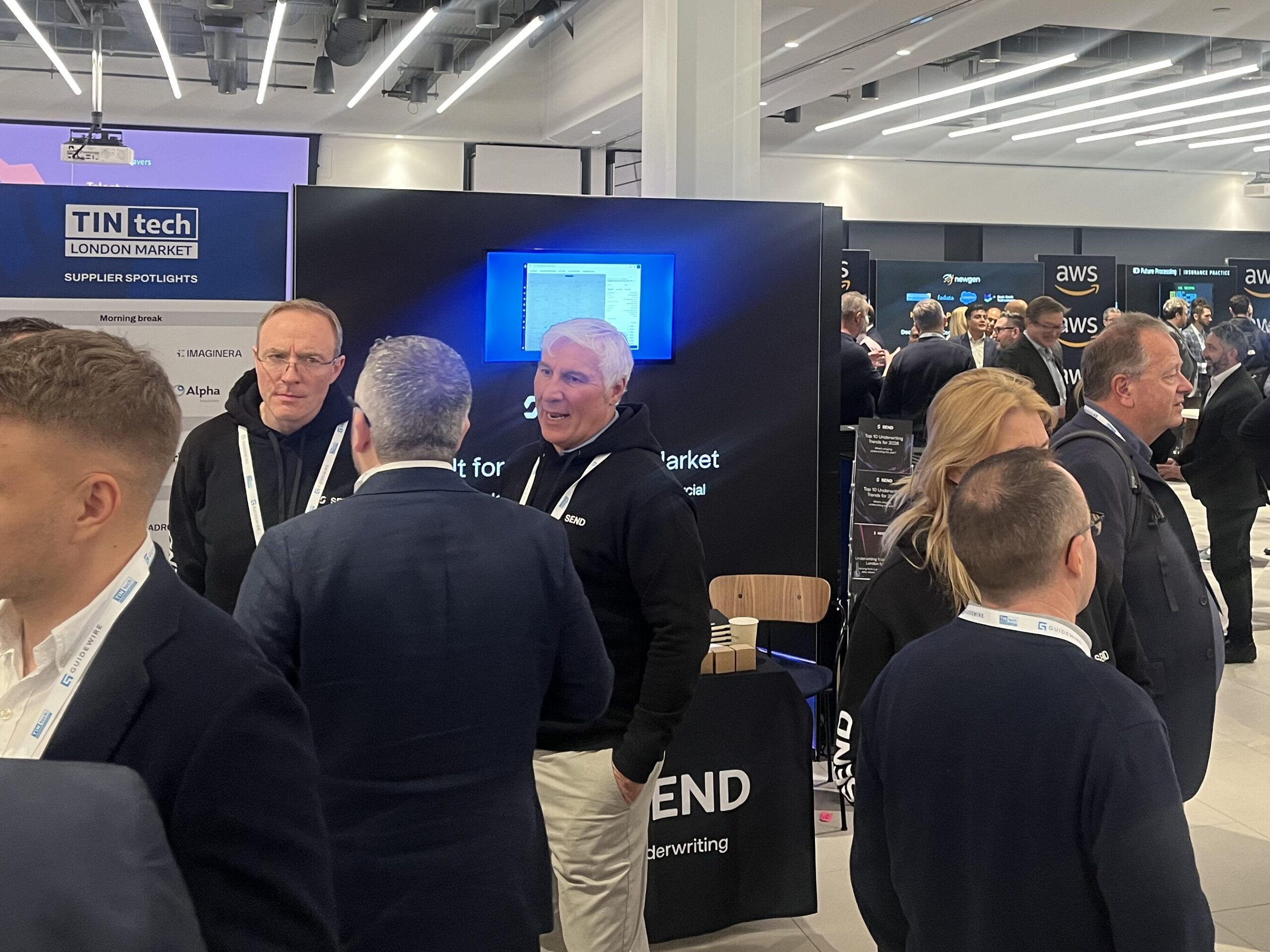
Jamie McDonnell of Guidewire reflected on the London Market’s pace of change. Compared to other global hubs, we’re growing – but more slowly. Yet history shows the market has “rarely failed to innovate on risk.”
The difference now? Knowledge is no longer power.
The differentiator is execution – executing knowledge at scale and at speed. Leverage and delivery capability will define who wins. The playbook may be widely understood, but translating strategy into repeatable, scalable outcomes remains the hard part.
This theme echoed throughout the day: the market doesn’t have an ideas problem. It has an execution problem.
2. Product thinking over project thinking
Few sessions resonated more than Christian Kitchen from Marsh, who challenged the market to rethink how it organises itself.
“We’re not choosing tools, we are choosing what type of teams we want to succeed.”
He emphasised three characteristics of high-performing teams:
- Clear ownership (only one person owns the outcome)
- Clear mission
- Clear runway
Projects end. Products continue. And product-level thinking – sustained investment in platforms that evolve over time – is foundational to long-term value creation.
Yet this is difficult work. It requires a solid platform beneath it. As Christian warned, layering AI or advanced analytics onto messy organisations simply creates “a faster mess.”
His advice on AI was strikingly pragmatic: if the foundations aren’t in place – data quality, controls, pipelines, contracts, clear data movement – the best thing to do with AI might be to stop.
Steady, stable, sensible – even “boring” – is not weakness. It’s how organisations become the fastest learners.
3. You can’t run Netflix on a VHS machine
That plumbing metaphor surfaced again in the AI discussions.
James Wright from Beazley put it bluntly:
“It’s not a technology problem, it’s a plumbing problem. Don’t try and run Netflix on a VHS machine.”
AI pilots often succeed in the first 80% – the prototype, the demo, the proof of value. The final 20% – embedding it into workflows, integrating with legacy systems, governing outputs, managing risk – is where projects stall.
Justin Albert at Hartford offered a helpful analogy: AI may be as transformative as electricity or the iPhone. But like Excel before it, it won’t make actuaries redundant. Instead, roles will adapt and evolve.
The five-year view? Everything changes. But only for those prepared to do the hard work beneath the surface.
4. Facilitisation is now mainstream
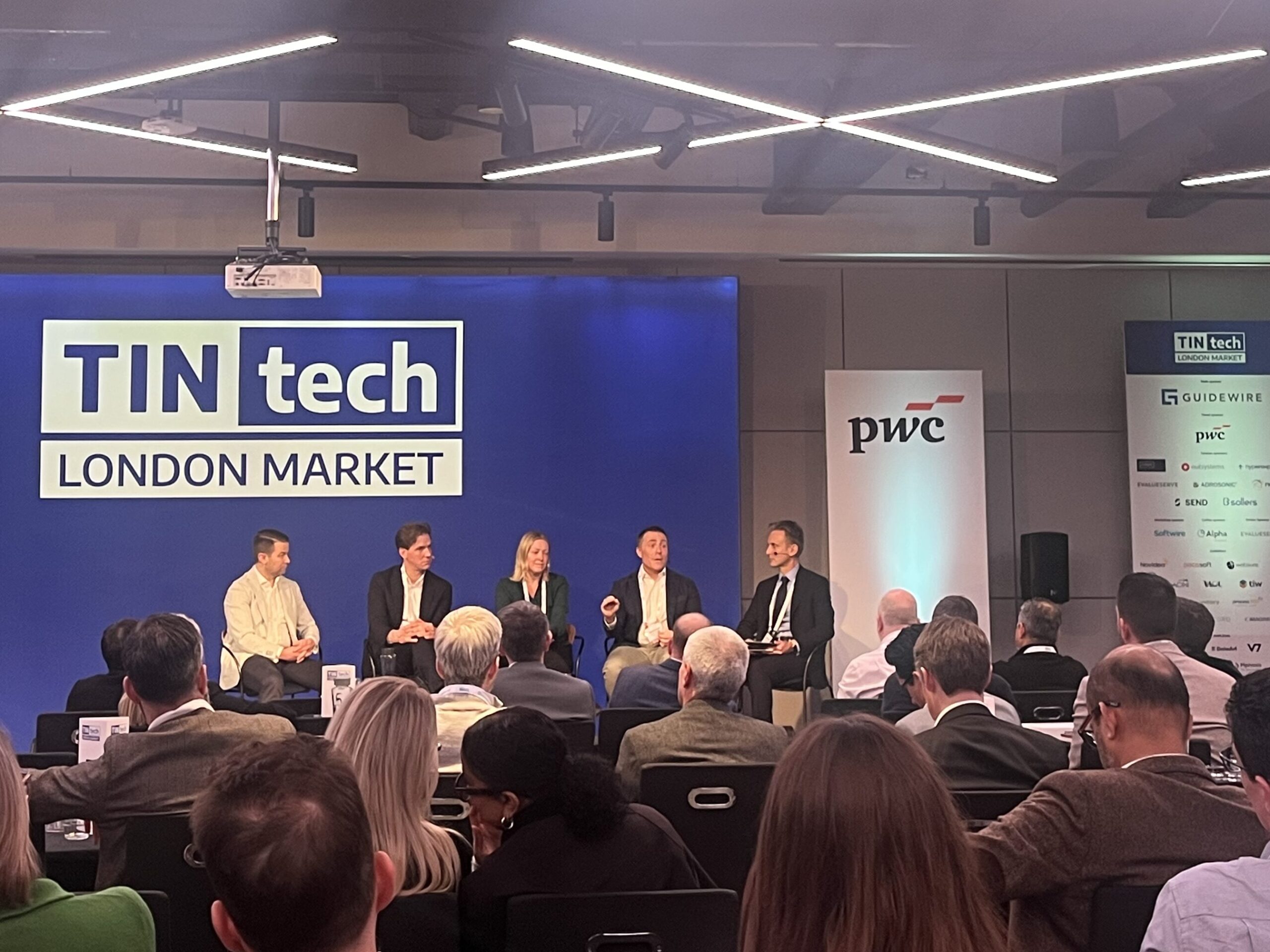
Send was proud to sponsor the session “Reshaping Facilitisation Through Digital,” which reinforced just how central this topic has become.
Facilitisation is no longer fringe. It’s a defining feature of the modern London Market.
Lloyd Peters from Send observed that the “true open market” may soon be the minority. Algorithmic underwriting and digital trading are reshaping the lead market itself.
The algorithmic market will digitise the lead – and that means data becomes essential from the start. You can’t power an algo strategy without structured, high-quality, accessible data.
Susan Andrews from Brit posed three critical questions for the audience:
- Strategy: Are you clear on your position? Lead or follow? How are you using digital to win? Who are your key partners in an ecosystem where it’s impossible to connect to everyone?
- Culture: Do your teams have the skills and mindset for a fast-paced, data-driven market? Are you measuring digital placement time and portfolio mix? Are insights from data analysts valued as highly as underwriting judgement?
- Technology: Will legacy systems – and beloved Excel raters – hold you back? Enabling technology is now table stakes. The analogue winners may not be the digital winners.
Insurers who are proactive across all three dimensions will be best positioned for success.
5. Curiosity, culture and accountability matter more than ever
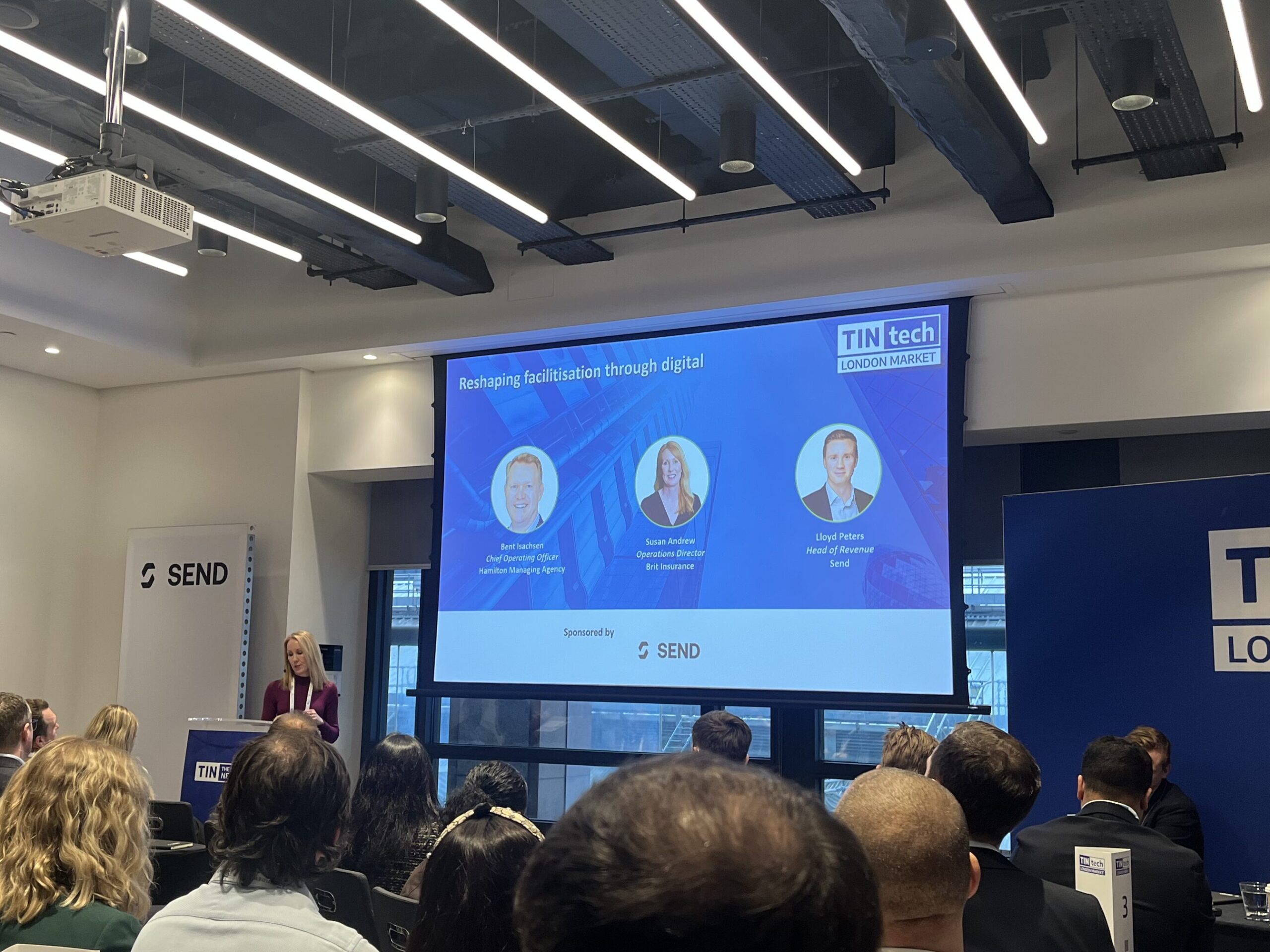
Carys Lawton-Bryce from Markel spoke about monetising the lead position and building a culture of curiosity and learning. Democratising AI – encouraging people to “play” with it – fosters engagement and capability building.
But experimentation must be balanced with discipline. Have the end state in mind. Be willing to pull technology that doesn’t deliver value. And get better at articulating value – internally and to vendors.
Underpinning all of this is accountability. Clear ownership. Clear outcomes. Clear investment across “run, grow, transform.”
The big message: foundations first
For a conference packed with digital ambition, the loudest message was cautionary – in the best possible way.
The London Market is evolving fast. Facilitisation is mainstream. The algorithmic market is reshaping the lead. AI will transform workflows. But none of it works without solid foundations.
Data hygiene. Stable infrastructure. Clear operating models. Product thinking. Cultural curiosity.
Technology will continue to accelerate. The question is whether firms are accelerating towards clarity or chaos.
At TINtech London, the consensus was clear: get the foundations right first. Only then can the market execute at the speed and scale required to win.
- Insights
- London Market
Related Resources


Underwriting Resources
Underwriting Maturity Framework: Moving from a process-driven to a data-driven operating model
Top 10 insurance industry trends shaping underwriting in 2026
