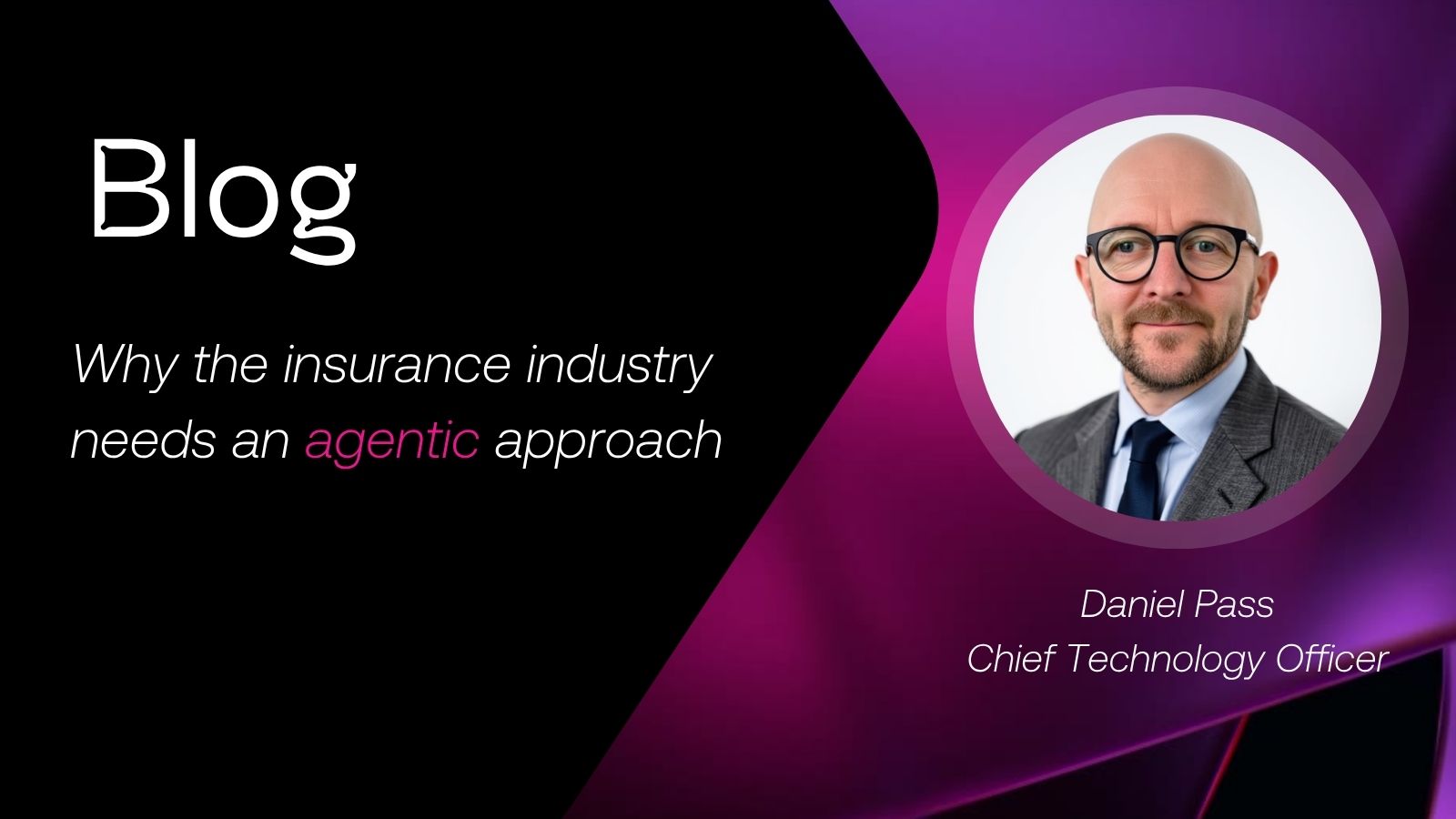
Why the insurance industry needs an agentic approach
Part 1 of 3 in the series Building the Agentic Underwriter
AI is everywhere in insurance right now. Every platform vendor mentions it, every pitch deck leads with it, and every conference has a panel on it. But when you look past the slides and into what’s actually running in production, it’s mostly document extraction, basic chatbots, and summarisation tools sitting on top of processes that haven’t really changed.
That work has value. But it’s no longer moving the needle in the way the industry needs.
The opportunity we’ve been focused on at Send is different. It’s not just about AI that reads documents faster (we have been able to do that for a long time). It’s about AI that can reason through an underwriting workflow. Triage a submission, check it against appetite, pull in relevant loss data, flag what looks off, and present a recommendation. Not replacing the underwriter, but working alongside them like a tireless co-worker who never clocks off.
That’s what we mean by an agentic approach. And it’s why we built the Send Agentic Framework.
What problem are we solving?
Many insurers have spent the last few years investing in AI. Many have strong models, good data, and real technical talent. But there’s a gap between having those capabilities and being able to use them safely, at scale, inside underwriting operations.
The problem isn’t the intelligence. It’s the infrastructure around it. Most organisations don’t have a governed, scalable way to let AI models actually do things within their workflows, rather than just advise from the sidelines. Everyone can build a prototype. What they can’t easily do is take that prototype into production with the controls, auditability, and operational rigour their compliance and risk functions require. That’s a different problem entirely.
That’s the gap the Send Agentic Framework is designed to close. It’s a platform for building, deploying, and governing AI agents that operate inside the underwriting workflow, not next to it.
What does “agentic” actually mean?
The term can often be misunderstood, so it’s worth being precise.
Generative AI creates content. You give it a prompt, it gives you text, an image, a summary. It’s reactive. It waits for instructions and produces output.
An agent is different. An agent takes a goal, breaks it into steps, picks the right tools, executes, and iterates. It doesn’t just answer questions. It completes tasks. Here’s a simple way to see the difference: ask generative AI to help with a property risk and it might summarise the submission documents for you. An agent, on the other hand, could take that same submission, check whether the location falls within your appetite, cross-reference the building specs against your guidelines, pull flood zone and catastrophe exposure data, and flag anything that doesn’t look right, all before the underwriter has opened the file. One gives you information. The other does work.
The important distinction is autonomy with boundaries. An agent that can act independently within a defined scope, but it operates under guardrails, with human oversight built in. Think of it as delegation, not abdication. You’re giving the agent a job to do, not handing over the keys.
Why did we build this now?
Three things came together that made this the right moment.
First, the models are better than ever. Large language models can now handle the parts of the kinds of reasoning underwriting demands: interpreting unstructured documents, applying complex rules, making judgement calls about data quality. Two years ago, the technology wasn’t there. Now it is.
Second, the regulatory picture is getting clearer. ISO 42001 has given the industry a concrete standard for AI management systems. The EU AI Act defines what conformity assessment looks like. For the first time, there’s a shared language for what “responsible AI” means in practice, which means organisations can build to a standard rather than guessing at one. Send is proudly ISO 42001 compliant.
Third, the competitive pressure is real. Carriers are processing more submissions, across more lines, with teams that aren’t growing at the same rate. The teams we work with have stopped asking “should we use AI?” and started asking “how do we use it safely, at scale, without creating a governance problem?” That’s a question that now needs a proper answer, rather than another proof of concept.
The framework in plain terms
The Send Agentic Framework is a platform that sits within our broader underwriting platform. It gives teams the tools to build, deploy, and manage AI agents, which we call microapps. These are apps that plug directly into the daily workflow.
A microapp is a small, purpose-built AI application designed to do one thing well. One might handle submission triage. Another might analyse a document set against underwriting guidelines. A third might monitor portfolio drift. Each one is self-contained, independently deployable, and governed by the same compliance and auditability controls.
These aren’t standalone tools that you have to switch into. They embed directly into the platform: in a side panel alongside the risk record, as a tab within the workflow, or autonomously as part of a full workflow application. The agent meets the end user where they already work.
Underneath all of this is a governance layer we built from the ground up. Audit trails, guardrails, fairness monitoring, human-in-the-loop controls, and alignment with ISO 42001. Not added after the fact. Foundational.
That governance layer is what separates a demo from a production system. It’s also what I’ll be getting into in the next two posts.
What’s next
In Part 2, I’ll walk through how agentic underwriting works in practice, with a company analysis agent that gathers intelligence in real time and a document Q&A agent that lets underwriters interrogate risk documents across sessions. I’ll show where the human stays in control, and why responsible AI in insurance must be an architectural decision, not an afterthought.
Daniel Pass is CTO at Send, where he leads the development of Send’s underwriting platform and Agentic AI Framework. Connect with him on LinkedIn.
- Insights
- AI
Related Resources
Underwriting Resources
Underwriting Maturity Framework: Moving from a process-driven to a data-driven operating model
Top 10 insurance industry trends shaping underwriting in 2026
