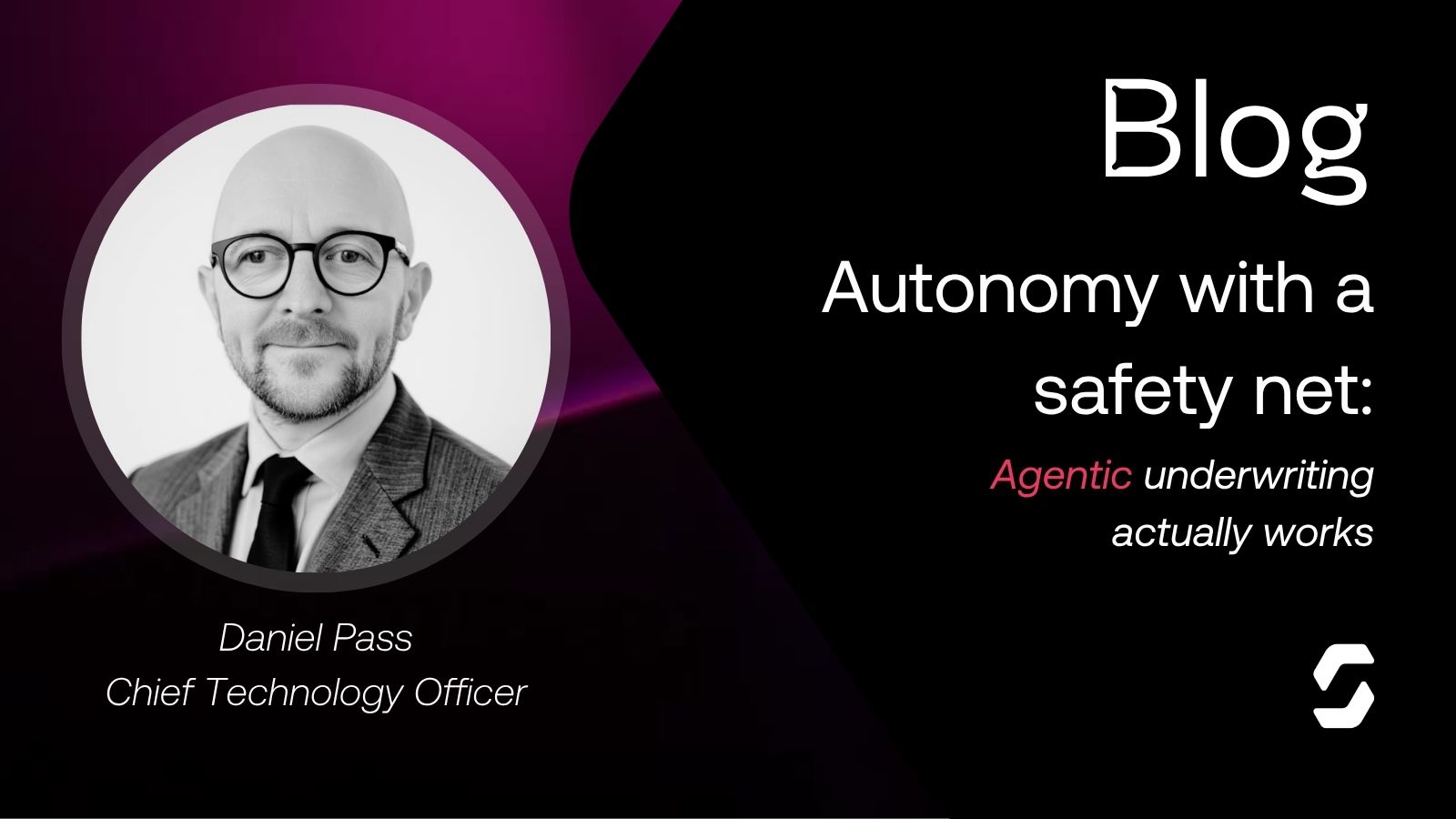
Autonomy With a Safety Net: How Agentic Underwriting Actually Works
Part 2 of 3 in the series Building the Agentic Underwriter
In Part 1, I talked about why the insurance industry needs a different approach to AI, one that goes beyond summarisation and chatbots toward agents that can reason through underwriting workflows. I introduced the Send Agentic Framework and the thinking behind it.
In this post, I want to get into how it actually works: how agents operate inside underwriting, where the human stays in the loop, and why responsible AI has to be baked into the architecture from the start.
How the framework enables more autonomous underwriting
The first thing to understand is that we didn’t build one large AI system and point it at underwriting. That approach is fragile, hard to govern, and nearly impossible to debug when something goes wrong.
Instead, the framework is built around the microapps concept I introduced in Part 1. Underwriting isn’t a single task. It’s a chain of judgements, and each microapp handles one link in that chain. Breaking it down this way means you can automate where it makes sense, keep humans in the loop where it matters, and trace what happened at every point.
Because these apps embed directly into the platform, the underwriter doesn’t have to change how they work. No context-switching, no separate login. The apps can be deployed anywhere in the lifecycle, and our codeless backbone, Agentic orchestrator, provides additional glue as needed to ensure seamless flows between worker agents.
On the development side, we’ve put a lot of effort into making it straightforward to build these agents well. The framework ships with a full development environment, containerised with zero local setup, that includes a web IDE (Integrated Development Environment), documentation, and local service simulation. An interactive scaffolding tool generates the structure for a new agent in seconds. And an embedded AI coding assistant with access to the full framework documentation helps developers build, test, and iterate quickly. The thinking here is simple: if governance is hard to implement, people will skip it. So, we made it the easy path.
How the framework balances automation with human control
This is the question I get asked most by carriers looking at agentic approaches. The insurance industry has spent decades building expertise, judgement, and institutional knowledge into its underwriting teams. No responsible technologist should be proposing we automate all of that away.
The Send Agentic Framework is designed around a principle we take seriously: the underwriter remains the decision-maker. The agent is the analyst.
Think about the work that happens before a risk reaches the underwriter’s desk — the triage, the data gathering, the document checks, the background research on the company. Our agents do the same preparation work, but faster and more consistently. One agent gathers company intelligence and market sentiment in real time. Another checks a submission pack for inconsistencies across documents. A third extracts and structures data from hundreds of pages of loss history. By the time the underwriter opens the file, the groundwork is done. But the underwriter still reviews, applies judgement, and makes the call.
The framework has built-in oversight and feedback controls. Every agent action can be reviewed. When an underwriter disagrees with an agent’s output and overrides it, that override is captured, not as a failure but as training data and a governance record. Override rates are tracked over time, so management can see how well agents are performing and where they need adjustment.
These map directly to ISO 42001 requirements around human oversight (A.9.4) and continual improvement (A.10.5). We designed the framework so that doing the right thing from a governance perspective is the path of least resistance. It happens by default, not because someone remembered to switch it on.
Why responsible AI is especially important in underwriting
There’s a reason I keep coming back to governance, and it’s not because compliance is exciting. It’s because the consequences of getting AI wrong in underwriting are serious in ways that other industries don’t face in quite the same way.
When an AI model influences an underwriting decision, it’s not generating a marketing email or summarising a meeting. It’s contributing to a decision that determines whether a business can get coverage, at what price, and on what terms. That has real financial consequences for the policyholder, the carrier, and the broader market. If the model carries hidden bias, whether against certain geographies, industries, or risk profiles, the impact is tangible. The result is someone not getting the cover they need, or being priced unfairly, or a portfolio developing concentrations that nobody intended.
This is why responsible AI in insurance can’t be a compliance checkbox. It has to be structural.
In our framework, this is built in at several levels. Fairness monitoring modules analyse agent outputs for bias using established methods like the four-fifths rule (a standard test for adverse impact), aligned with UK Equality Act and US AI Action plan protected characteristics. These aren’t annual reviews. They run continuously and flag disparities as they emerge.
Guardrails operate on both inputs and outputs. Configurable PII (Personal Identifiable Information – sensitive personal data) detection ensures sensitive data is handled correctly. Content filtering catches inappropriate or out-of-scope responses. Profile-based rules enforce boundaries on what agents can and cannot do. These are set per agent, so a triage agent and a pricing agent can have different guardrail profiles appropriate to their function.
Underneath all of this, structured audit logging with correlation IDs means every interaction, every input, every output, every tool call an agent makes, is recorded in a traceable, exportable format. When your compliance team asks “why did the AI recommend this?”, you can show them the full chain of reasoning. Not a black box.
That’s the difference between a demo and a production system. Demos look impressive. Production systems have to be trustworthy.
What’s next
In the final post of this series, I’ll go deeper into governance and auditability: how the framework aligns with ISO 42001 at the module level, what regulation means for agentic systems, and what I think this shift means for the broader insurance industry.
Daniel Pass is CTO at Send, where he leads the development of Send’s underwriting platform and Agentic AI Framework. Connect with him on LinkedIn.
- Insights
- AI
Related Resources
Underwriting Resources
Underwriting Maturity Framework: Moving from a process-driven to a data-driven operating model
Grow your delegated underwriting