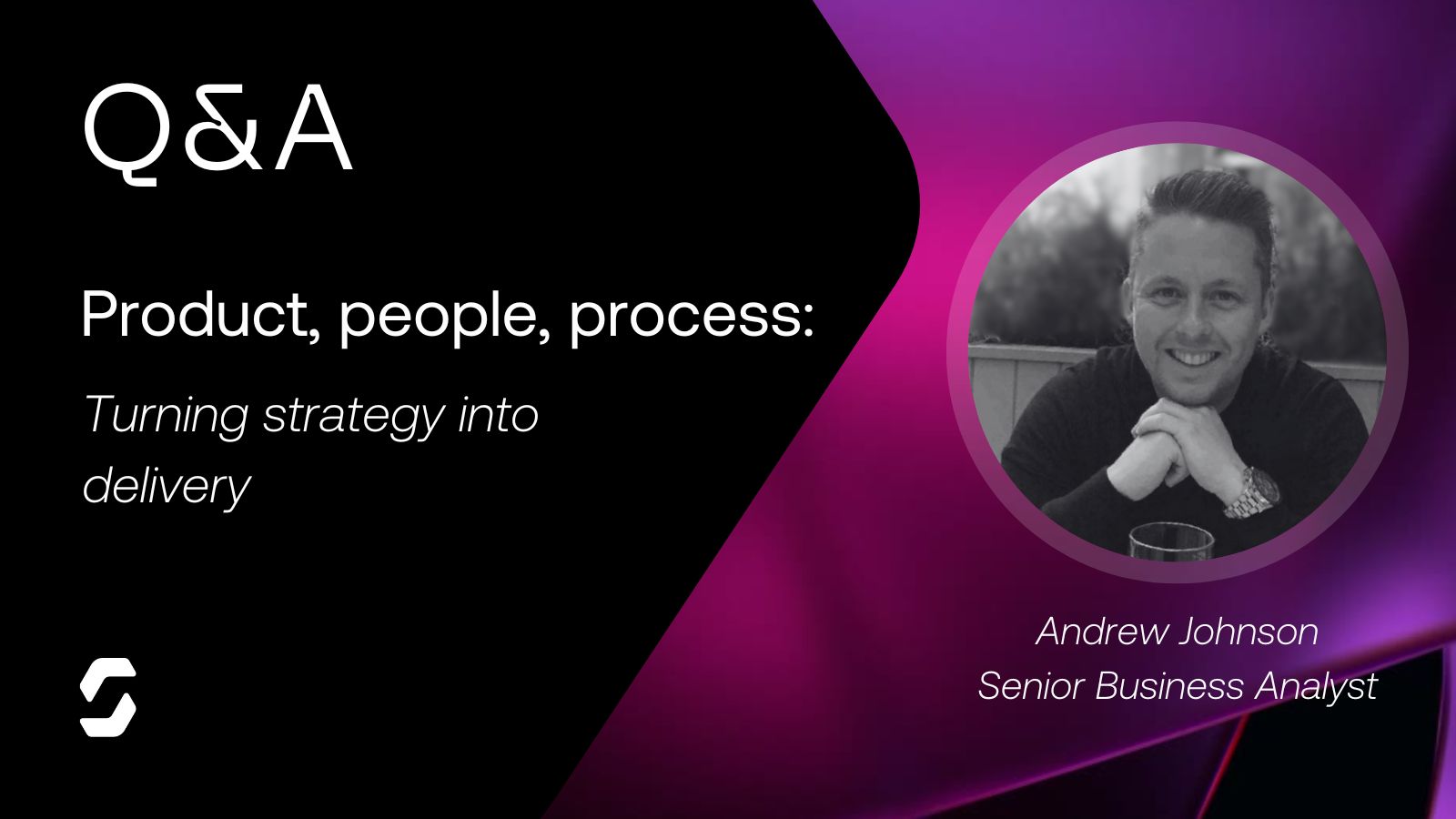
Bridging product, people, and process with Send’s Senior Business Analyst, Andrew Johnson
In this edition of our Q&A series, we speak with Andrew Johnson, Senior Business Analyst at Send, about acting as the connective tissue between customers and technology, how the role has evolved alongside the company’s growth, and why clarity, challenge, and speed now define successful underwriting transformation.
What does your role as Senior Business Analyst involve on a day to day basis?
A lot of my role centres around engagement. I act as the conduit between our clients and the internal teams at Send. On a typical day, that means syncing with our delivery teams so everyone is clear on priorities, then working closely with customers to answer questions, gather feedback, and keep things moving.
A big part of the role is knowledge ownership. Internally, I know everything about the client’s workflows and business processes. Externally, I know the Send platform inside out, so I can guide customers towards solutions that genuinely add value and ensure everyone is aligned. There’s also a strong element of challenge. Customers may not always know what they actually need, so part of the job is helping them test their assumptions and find better, often simpler ways to achieve the outcome they want.
How has your role evolved since you first joined Send?
It has changed significantly. When I joined around four years ago, Send was much smaller, and the focus was heavily on delivering exactly what each customer asked for. As the business has grown, the role has become more strategic. I now have much more autonomy and a broader remit. I’m also far more involved with prospective clients, running demos and helping shape early conversations before they even sign with us. That shift reflects the company’s maturity. We are no longer just reacting to individual client needs; we are thinking about how those needs shape the core product and where the platform should go next.
What originally attracted you to Send?
I was approached by someone I had worked with previously, which started the conversation. What really sold it for me was the people. From the first discussions with the founders and early team members, there was a clear belief in what they were building. The enthusiasm was genuine, not forced. The insurance platform space had been overlooked for a long time, and it was obvious that Send was approaching it with fresh thinking and intent. It felt like a product that could genuinely move the market forward, rather than just add another layer of technology.
What do you think sets Send apart from other businesses in the market?
The product depth and how much it has expanded. Initially, the focus was on the core underwriter workbench and tracking work through the process. Now the platform spans smart submissions, automation, straight-through to processing, and increasingly advanced capabilities. The breadth has grown without losing direction. That is helping Send become a central part of underwriting operations rather than just another tool on the side.
How would you describe the culture at Send and its impact on how you work?
The culture gives you real autonomy. There is very little bureaucracy. If a client needs something and it makes sense for them and for Send, I have the freedom to push that forward and work directly with development teams to make it happen. That level of trust makes the work more rewarding and creates a strong sense of ownership. You are not just passing messages along; you are actively shaping outcomes.
Which skills from earlier in your career have been most valuable in your current role?
Being able to talk to people, challenge them constructively, and dig into what they are really asking for is critical. Customers often request a solution that does not fully address their underlying problem. Helping them unpack that takes patience and confidence. Over time at Send, I’ve also developed much stronger technical knowledge. Working closely with developers has given me a much better understanding of APIs, data mapping, and how systems are actually built. That’s been invaluable and helps when dealing with customers with technical backgrounds.
What challenges and opportunities come as Send continues to scale?
No two customers work the same way. Even within the same company, different lines of business often have completely different workflows. Delivering value in a way that is as agnostic as possible is difficult. Many customers are deeply attached to existing processes, even when those processes are inefficient. The challenge is finding creative ways to meet their needs without forcing unnecessary change, while still encouraging better ways of working where possible.
How do you keep business goals, teams, and delivery aligned?
Communication is everything. We regularly share what teams are building and demo work internally so everyone understands what’s happening across the business. That knowledge can then be passed on to customers, which helps them see value beyond their immediate requirements. When clients know that something is being built as part of the wider platform, it creates confidence and reduces friction later on.
Which areas of the Send platform do you find most interesting?
AI is the area that has my attention. Alongside automation and straight-through processing, AI has the potential to deliver real, practical value for clients. It is not about hype; it is about improving decision-making and reducing unnecessary effort. Working closely with development teams on this has been one of the most interesting parts of my role recently.
How do you see Send evolving over the next few years?
Growth is quick, and with more customers comes more complexity. The direction is clear, though. Send is evolving to remove duplication, reduce friction, and help underwriters focus on the work that actually drives value. Speed is what customers care about most. Getting from submission to decision faster, with fewer clicks and fewer handoffs. Everything we are building now is geared towards that outcome, helping customers spend their time where it really matters.
Connect with Andrew on LinkedIn here.
- Team Spotlight
Related Resources

Underwriting Resources
Underwriting Maturity Framework: Moving from a process-driven to a data-driven operating model
Top 10 insurance industry trends shaping underwriting in 2026
