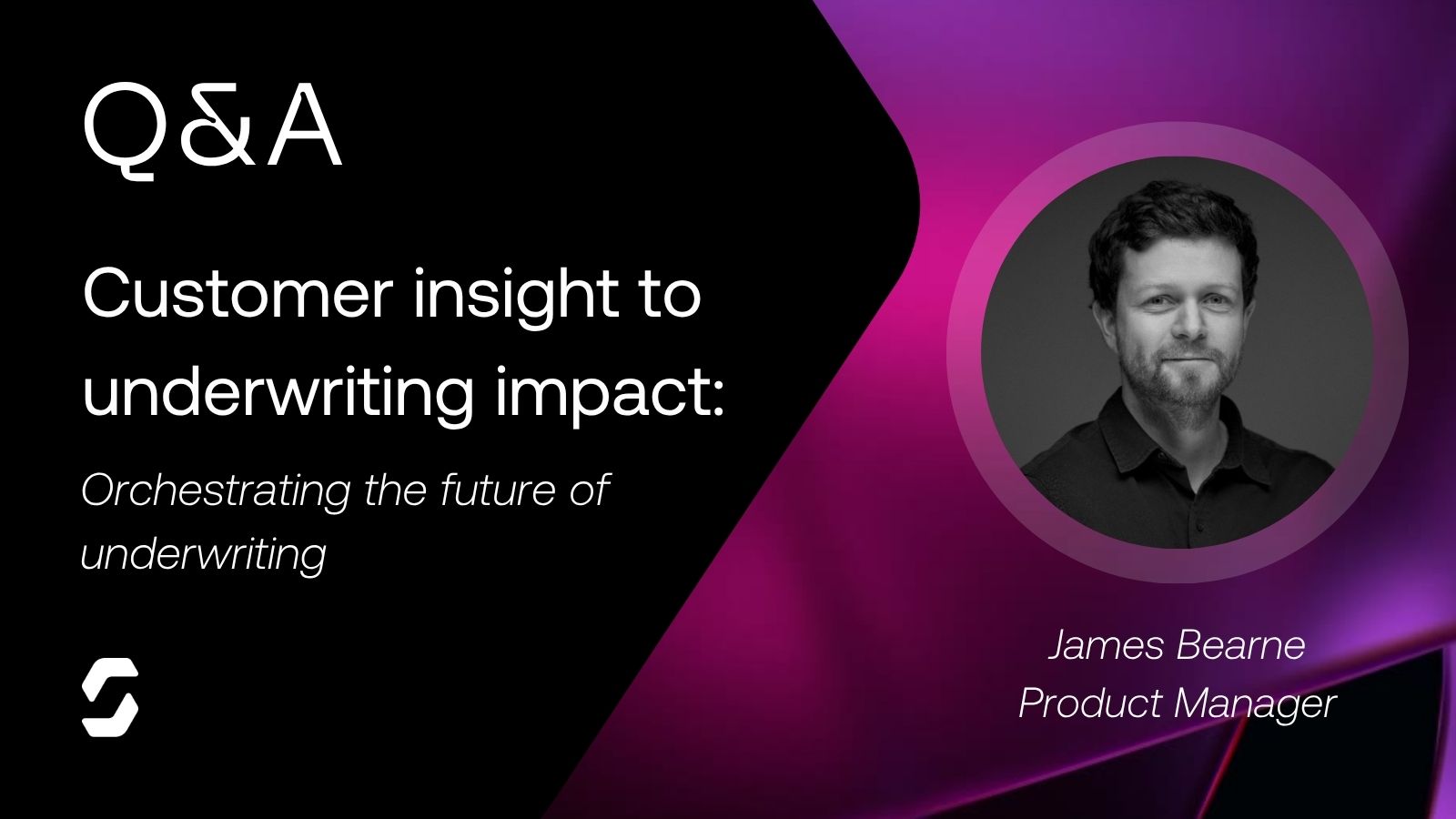
Driving product value through customer understanding with Product Manager, James Bearne
In this edition of our Q&A series, we speak with James Bearne, Product Manager at Send, about his approach to building technology for commercial and specialty insurance – and why understanding the art and the science of underwriting is at the heart of everything he does.
How would you describe your role as a Product Manager at Send?
I’ve been at Send for over four years now. I actually started as a Delivery Manager, working closely with new and existing customers to implement the platform.
Over time, I became more interested in improving the product experience itself, both for end customers and delivery partners. That led me into product management.
Today, my role is centred around understanding what we should invest in and why. It’s about identifying key problems within the platform, whether that’s gaps in capability, user experience challenges, or broader business needs, to make sure we invest our engineering time in the right areas.
A big part of the role involves gathering feedback from customers, partners, and internal teams, identifying common themes, and working with designers and engineers to prioritise and shape what we build next. The goal is always to understand whether a challenge is a process problem we can systematically improve, or a judgement call that requires a different kind of solution entirely. Getting that distinction right is what drives real impact.
What are your key responsibilities when it comes to delivering value to customers?
It really comes down to understanding what kind of problem they are facing.
It’s easy to jump straight to solutions. Feedback might suggest, “we need this feature,” but the real value comes from taking a step back and asking: what is the underwriter actually trying to achieve, and is this a process we can engineer away, or a judgement call we should support rather than replace? In commercial and specialty insurance, that distinction matters enormously, and good product decisions depend on knowing which one you’re dealing with.
A big part of my role is digging into that question. That often means challenging assumptions, asking follow-up questions, and working through feedback from different angles to get to the root of the need rather than the surface-level request.
Just as importantly, it’s about bringing the wider team along in that thinking. Product decisions work best when designers, engineers, and stakeholders all share the same understanding of the problem we’re solving. That makes the solutions we build genuinely more effective – not just technically sound, but right for the way underwriters actually work.
How does that philosophy influence how you prioritise product features?
We take a very broad approach to gathering input. That includes feedback from customers, insights from the sales pipeline, and internal expertise from across the business.
Once we’ve pulled all of that together, the goal is to define a clear problem statement. From there, prioritisation becomes much easier. Instead of debating individual features in isolation, we anchor decisions around the problem we’re trying to solve.
What challenges are you seeing in the industry right now?
In the commercial and specialty insurance space, there’s a huge opportunity for technical innovation in the underwriting process, especially with newer technologies coming into play.
A lot of workflows are still quite manual and admin-heavy, which takes time away from what underwriters actually want to focus on, making informed decisions and writing profitable business.
There’s a strong push towards automation, better use of data, and more efficient processes. The goal is to remove that administrative burden, give underwriters better insights, and enable them to work faster and more effectively.
What attracted you to Send?
Before joining Send, I spent about a decade in management consulting, working across financial services, including banking, and insurance. I was looking to move into a startup environment and already knew the founders from a previous project – which meant I came in with confidence in the team, their ambition, and how they worked together.
What really stood out was their vision for modernising underwriting. It’s a domain that is deeply complex and most technology companies either underestimate that complexity or try to engineer away entirely. Send’s approach was different: build technology that respects and enhances that complexity, rather than flattening it. That felt like the right way to think about the problem.
It felt like a natural next step, and an opportunity to have a meaningful impact.
How has your previous experience shaped your approach today?
Consulting trains you to define the problem rigorously before reaching for a solution. You quickly learn that the initial symptom is rarely the real issue – and that the most expensive mistakes happen when you skip that step. That instinct has shaped everything about how I approach product management.
In a domain as nuanced as commercial and specialty insurance, where every workflow has both systematic and human elements, that discipline is important. You must be genuinely curious about root causes, not just responsive to surface-level requests.
What sets Send apart from others in the market?
One of the biggest strengths at Send is that we genuinely understand the domain. Commercial and specialty underwriting has both an art and a science to it – experienced judgement on one side, structured process and data on the other. A lot of technology in this space tries to solve for one at the expense of the other. We design with both in mind.
The other key differentiator is our focus on orchestration. Rather than solving isolated parts of the workflow in silos, we take a step back and look at the entire underwriting journey end to end. That includes how different stages connect, how data flows through the process, and how underwriters actually interact with the system.
That end-to-end perspective, combined with the flexibility to integrate with third-party tools where it makes sense, allows us to meet customer needs. Instead of forcing a rigid, one-size-fits-all approach, we can support different operating models while still maintaining a connected experience across the underwriting lifecycle.
What excites you most about the future?
What excites me most is how much of underwriting is still ahead of us, not behind us. The process has been manual for decades because the complexity of the domain made it hard to do well any other way. Better data, smarter tooling, and a deeper understanding of how underwriters actually think and work means we can finally build technology that shifts how the industry operates – not just digitises what was already there.
For me personally, it comes back to the art and the science. The more we can automate and streamline the science – the repeatable, data-driven parts of underwriting – the more space we create for underwriters to focus on the art: the judgement, the relationships, the decisions that require real expertise.
Connect with James on LinkedIn here.
- Team Spotlight
Related Resources
Underwriting Resources
Underwriting Maturity Framework: Moving from a process-driven to a data-driven operating model
Grow your delegated underwriting