Putting agentic AI into underwriting practice
Underwriting teams want to make better decisions and make them faster. Agentic AI can improve efficiency by gathering information, validating submission data and checking appetite. But the greater value comes from redesigning how underwriting work gets done: deciding where agents can act, when an underwriter should take over and how decisions move through the workflow.
A new Datos Insights whitepaper, Agentic AI for Insurance Underwriting: The Playbook That Works, explores how carriers can approach those decisions – setting out the foundations for adoption and a phased path towards greater responsibility for AI.
Building the foundations for agentic underwriting
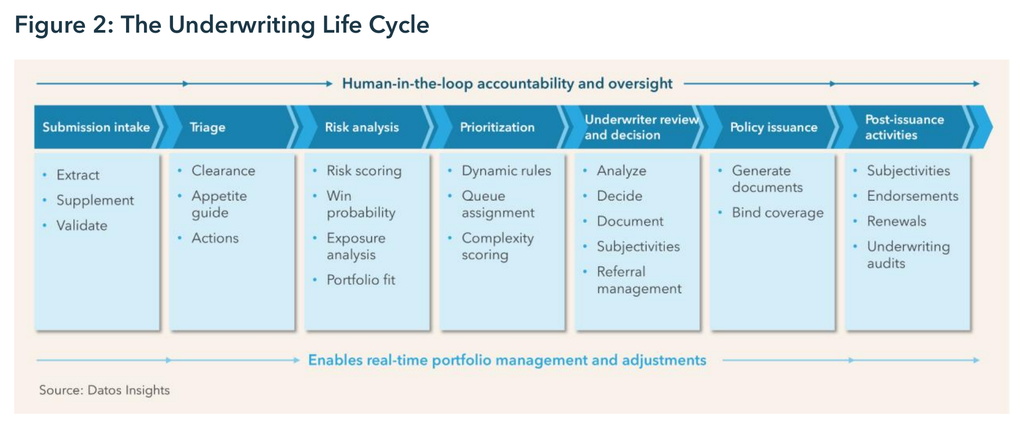
Agentic underwriting depends on current, consistent context. That includes submission information, product definitions, business rules, risk information and an understanding of the workflow an agent operates within.
That context needs to remain consistent as an approved underwriting decision moves towards quoting, binding and policy issuance. Consider a product rule that has been updated in underwriting while the policy system holds an earlier version. The risk could be assessed under one set of assumptions and issued under another, creating discrepancies and rework.
Integration, versioning and reliable handoffs help carriers keep underwriting and policy systems aligned. Where systems share a product definition source, that can help keep the information consistent. Connection alone is not orchestration. Orchestration determines what happens next: which agent, workflow, system or person should act, what authority they have, what must be escalated and how approved decisions move into execution.
The same attention needs to extend to decision authority. An agent validating data has a different role from one recommending an appetite match or taking an action in a workflow. Carriers need to define that scope, the thresholds that trigger human review and who is accountable for setting them.
An underwriter reviewing an exception also needs visibility of the context used and actions already taken. Building traceability and referral paths into the workflow gives the team a way to review the work and intervene when needed.
A measured path to adoption
The report sets out a phased adoption path, using operational evidence to guide how much responsibility AI takes on.
- The foundation stage includes assisted underwriting. AI makes recommendations and people affirm or override them, allowing the carrier to test its governance framework before granting autonomy. This is also the time to establish baseline measures: how long each step takes, how much human effort it requires and where delays occur across the underwriting journey.
- The next stage is a focused pilot. This might involve appetite matching or data validation on lower-risk small commercial submissions. Every decision remains subject to human review, with no autonomy granted at this point. The team measures accuracy, consistency, speed and the effectiveness of controls, then uses the results to refine rules and thresholds.
- That review gives underwriting leaders evidence for deciding where selective autonomy may be appropriate. Authority is granted for defined submission types, decisions and risk profiles, with exceptions routed to people. Monitoring continues as the agent takes on those responsibilities, and changes to its decision logic, thresholds or scope remain subject to human review and approval.
- Scaling follows the same principle. Carriers can extend the approach to additional tasks and risk segments as performance and controls are validated. Feedback from claims outcomes can inform further improvements, with human governance confirming whether resulting changes are appropriate.
Governance precedes autonomy. It does not follow it.
— Meredith Barnes-Cook, Datos Insights
Throughout this progression, the baseline helps leaders assess what is changing. Cycle time matters alongside accuracy, consistency, human effort and governance performance. Those measures help determine whether AI is creating capacity for underwriters to focus on complex risks, exceptions and relationships.
Expansion should depend on the workflow and risk profile. A successful pilot provides evidence for that specific scope, while additional tasks bring further requirements for data, decision authority and oversight. Orchestration between underwriting and policy is foundational: it keeps those requirements connected as scope grows.
Explore the full playbook
Send is an underwriting orchestration engine that coordinates submission information, risk context, AI-supported tasks and underwriter judgement across underwriting workflows. It can work alongside a carrier’s existing policy administration system or with Duck Creek Policy, supporting the connections between underwriting work and policy execution.
For underwriting leaders planning their next steps, the full Datos Insights report sets out readiness considerations, success measures for each adoption phase and questions to ask prospective providers, including whether a solution is designed to orchestrate AI agents, people and processes or operates as a stand-alone system.
Download Agentic AI for Insurance Underwriting: The Playbook That Works to explore the full framework.
- Insights
- Trends
Related Resources
Underwriting Resources
Underwriting Maturity Framework: Moving from a process-driven to a data-driven operating model
Grow your delegated underwriting