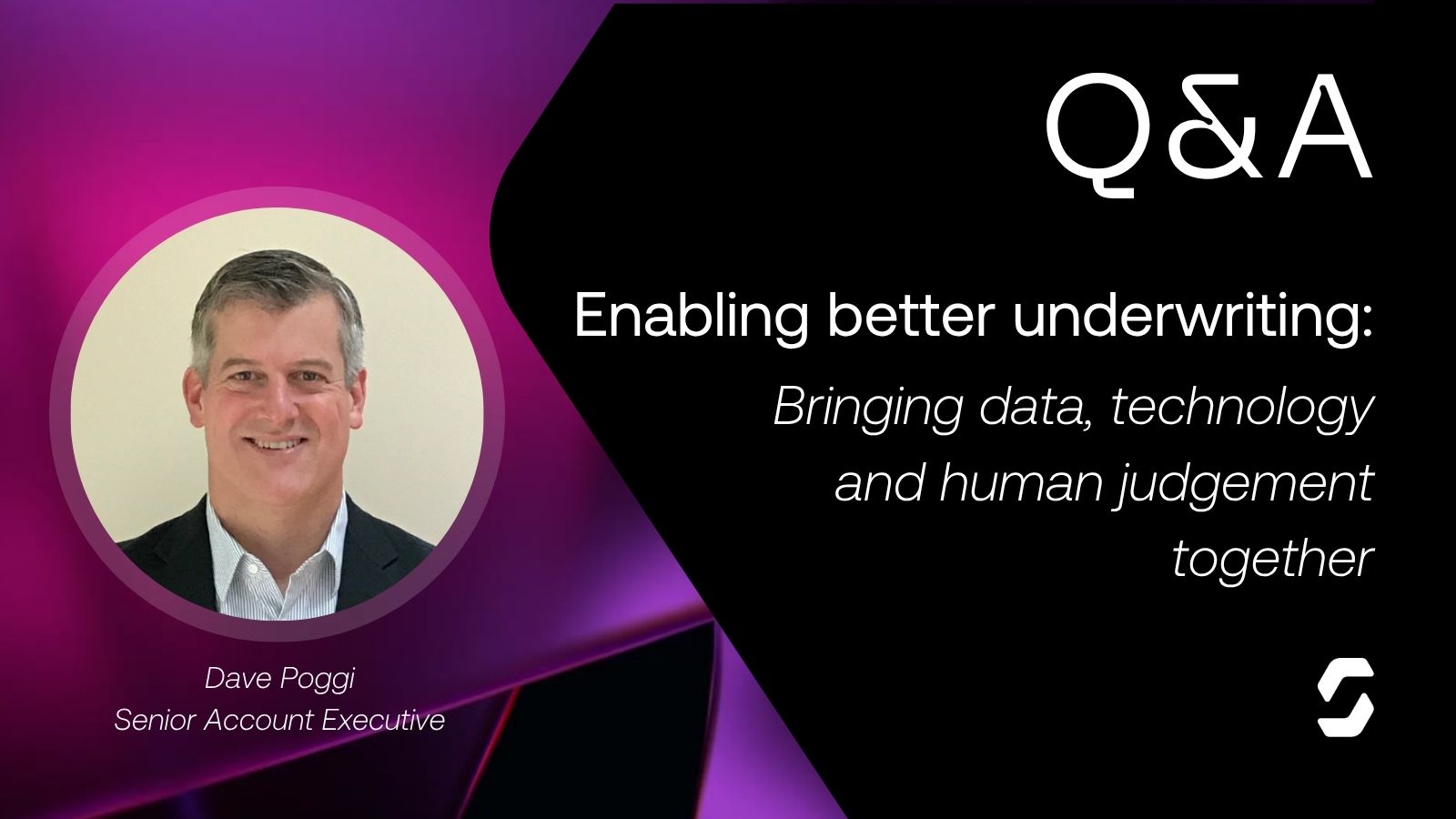
Send Q&A with Dave Poggi, Senior Account Executive
Bringing insurance expertise, technology and customer insight together with Senior Account Executive, Dave Poggi
In this edition of our Q&A series, we speak with Dave Poggi, Senior Account Executive at Send, about his journey from commercial insurance and sales leadership into insurance technology. Dave shares what attracted him to Send, why the balance between business and IT was a key part of the appeal, and how his experience across insurance, SaaS and systems implementation shapes the way he works with customers today. He also discusses what sets Send apart in complex underwriting, the importance of enabling underwriters rather than replacing them, and the collaborative culture that comes with being part of a growing technology business.
What brought you to Send?
I’ve spent my career across a variety of roles, starting in insurance with a commercial carrier where I spent around 10 years and gained exposure to different capabilities across the business. From there, I moved into sales and worked with some very large organisations, including Fortune 500 companies and major SaaS businesses, as well as startups that had already reached a certain level of scale.
What attracted me to Send was the opportunity to bring all of those experiences together in a company that was looking to establish itself in the US market. I felt I could bring what I had learned in insurance and sales leadership at larger SaaS companies and apply it in a different environment.
Ultimately, though, it came down to two things: people and product.
I had a former colleague who had already joined Send, and through conversations with him and other people across the business, including sales, product and the executive team, what stood out was how genuine and excited everyone was about what they were doing. They were insurance people selling an insurance product, rather than salespeople who happened to be working in an insurance vertical.
The product was equally compelling. When I was researching Send, I felt it represented a really strong underwriting workbench for both business and IT needs.
What was it about the product that stood out to you?
I’ve worked at software companies that started with a large, monolithic product and then built or acquired additional capabilities, eventually trying to stitch everything together and tailor it to different industries.
I’ve also worked with software platforms where everything is essentially built from scratch for each customer. Both approaches have their trade-offs. You can end up compromising on flexibility, implementation time, cost, time to market or customer control.
What struck me about Send was that it offered something different. It was an underwriting workbench and orchestration tool built by people who understand insurance.
It starts with the data. In underwriting, you need to bring information from different sources together and make it accessible to the underwriter. At the same time, you have to recognize that unless you are working with a startup, every insurer or MGA has already made investments across its technology stack. You need to work cohesively with those systems rather than trying to replace everything that is already there.
Our platform provides end-to-end capabilities but still allows insurers to tailor those processes around what makes them different. That means you can get started quickly, but you can also iterate. You can align the platform with your internal processes, develop your own intellectual property and build your processes the way you want to underwrite.
For me, it offered the best of both worlds. IT gets a framework and flexibility to work with, while the business gets a significant accelerator to value rather than having to spend all its time getting to table stakes.
You’ve now been at Send for more than a year. What has happened during that time that stands out?
What stands out of course, is the acquisition by Duck Creek, which was announced in July. We still have the camaraderie that existed within Send, and we remain a standalone orchestration platform. That means customers who have already invested in other technology can still use Send over the top of those systems rather than having to move everything to Duck Creek.
My background includes working for a carrier that had grown through acquisition and ended up with multiple policy administration systems. There are plenty of insurers I work with as customers in a similar position, whether they're evaluating new PAS capabilities, managing multiple systems or going through a transition.
At the same time, there is a lot of potential acceleration from working with Duck Creek. Having those additional resources behind the roadmap is really exciting, and I think the next several months will be particularly interesting as we see how that develops.
Send remains a viable solution in those situations, and the acquisition has effectively turbocharged what the platform can do.
How has your experience across insurance, sales and technology shaped your approach at Send?
I’ve been a commercial underwriter (for a hot minute), a financial VP for a large commercial insurance region, a sales leader and a systems implementer. I also started my career working on things like building contact centers, and at my core I’m probably a bit of a process geek.
When you put all of those experiences together, I’m constantly thinking about the business impact of the products we offer.
How can we use Send to improve customer outcomes? How can we bring value to underwriting faster? How can we help companies decide which tools to use and when?
AI is an obvious example. You can’t go very far in the industry today without somebody talking about AI. I’m interested in helping customers work out where AI makes sense, where more traditional approaches might be more appropriate, and where they can achieve the outcome they need in a more cost-effective way.
My experience also reminds me that the industry is constantly changing. Some of the things I learned earlier in my career are still relevant, but customers are facing new challenges too. So a big part of my approach is listening and learning.
At Send, I can take a customer challenge and go directly to product, solutions engineering or other people across the business and ask whether they’ve seen something similar and how we might solve it. There’s a flexibility there that you don't always get in large businesses.
What does a typical day look like?
A big part of my role is connecting the dots.
That could mean speaking to a customer and understanding what they actually need from a business perspective. It could be running strategy sessions internally with sales, product, solutions engineering or delivery to understand how we might solve a particular problem.
I’m also constantly looking for patterns across the conversations I’m having with prospects. If I hear similar challenges from multiple organisations, I can take that market intelligence back to the team and think about how we might configure the product, demonstrate it or develop our approach.
It’s about taking those individual conversations and connecting them to broader trends. If something works well with a customer, we can learn from it and think about where else it might apply.
I don’t necessarily make all of those decisions myself, but I can collect that insight, share it across the team and help us understand what customers are facing and where we should go next.
What sets Send apart from others in the market?
Well, circling back to the Duck Creek acquisition, I would argue there are few that can match our depth of capabilities. But focusing on the core Send offerings, one of the biggest differentiators is our focus on complex underwriting.
There’s always a new technology trend. It might be automation, machine learning, or AI. A few years ago, it was blockchain. But leveraging the technology itself isn't necessarily what differentiates Send.
What matters is how you apply it to underwriting. Complex underwriting isn't simply about using AI to produce the recommended coverage or price a risk. There is still a very important role for the underwriter. There is an art to underwriting – one that I admittedly never mastered -- and I think Send recognizes that.
Our approach starts with the data and brings that information to the underwriter so they can make better decisions and influence the process. There may be parts of the market where a more automated, black-box approach makes sense. But complex underwriting requires something different.
The way Send has tailored itself to support complex underwriting is a genuine differentiator. It's about enabling the underwriter rather than replacing them.
What’s it like working at Send?
At Send, there’s more flexibility and ownership. What I particularly enjoy is the camaraderie. When you’re working on a deal, sales aren’t simply going away and doing everything on its own. There’s coordination across delivery, product and other teams throughout the organization.
Working on those opportunities together means you build relationships with people across different disciplines, all working towards the same goal.
I also feel empowered to contribute. If I’ve seen something done better somewhere else, I can suggest it and share examples. And although I’m currently an individual contributor, I’ve been in sales leadership before, so I enjoy being a sounding board for colleagues and helping them think through their deals and the business problems their customers are trying to solve.
There’s a great rapport across the team. We work hard, but we have fun together too.
What has been your proudest moment at Send?
For me, it’s actually a two-part answer. The moment I felt proudest was the day after I closed my first deal, but a close second was when the MVP went live just under 5 weeks later.
When you close a deal, you let the wider business know what you’ve achieved. I took the opportunity to write an internal note thanking everyone who had contributed along the way, from the initial RFP through customer presentations, meetings, explanations and all the other work involved in getting a deal over the line. I wanted to recognize everyone who had played a part.
When you get that moment of relief after closing a deal, celebrating the sale is great, but being able to thank the people who helped make it happen was incredibly rewarding.
And, of course, the job doesn't finish when you make the sale. The next stage is implementing the software and getting the customer to the point where they start to recognize the business benefits you've talked about throughout the process.
One month after that first sale, one of my key contacts at the customers shared a note celebrating how fast our delivery team implemented and rolled out the MVP – something they hadn’t seen in their whole career.
Nor, for that matter, had I. Our delivery team helped the customer achieve their objectives in record time!
Dave works with insurers and MGAs across the US market. Connect with him on LinkedIn here.
- Team Spotlight
Related Resources
Underwriting Resources
Underwriting Maturity Framework: Moving from a process-driven to a data-driven operating model
Grow your delegated underwriting